Dead and hazard tree removal in Cookeville
Trees that are dead, cracked, leaning or just in the way, and how they come down safely.
Most removals around Cookeville fall into one of three groups: a tree that's already dead, a tree that's alive but leaning or cracked over something you care about, and a healthy tree that's simply in the wrong place for an addition, a driveway or a garden. How it comes down depends far more on what's under it than on the tree itself.

Things that usually prompt the call
- No leaves in late spring on part or all of the crown, or bark falling away in sheets.
- A crack running down the trunk, or a fork that's splitting apart.
- A new lean, especially with soil heaving up on the opposite side.
- Mushrooms or soft, crumbly wood at the base.
- On ash: thinning from the top, woodpecker damage and small D-shaped exit holes about 1/8 inch wide. On pine: pitch tubes on the bark and needles turning red. See the pest guide.
Only someone who looks at the tree in person can say whether it's actually a hazard. A contractor's quote visit is a good time to ask.
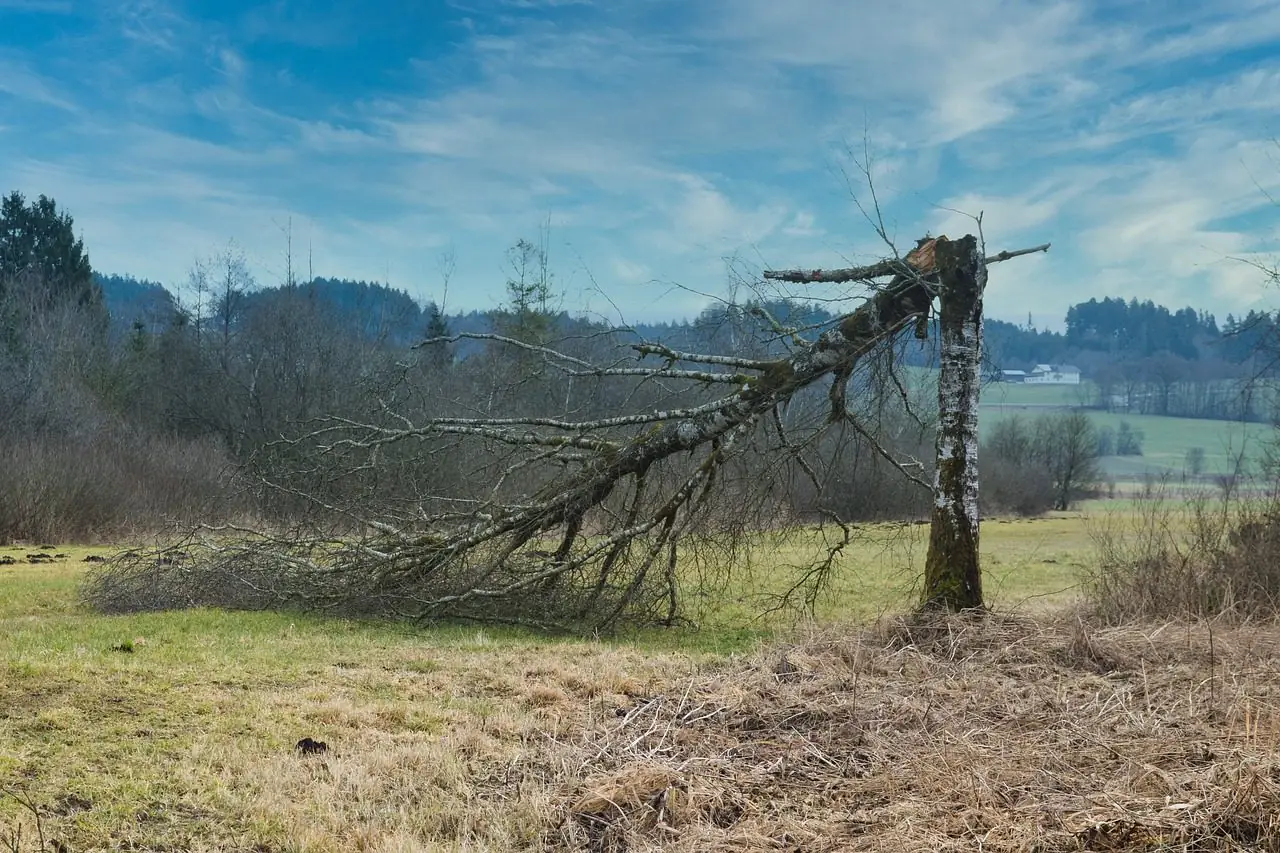
Felled whole, or taken down in pieces
With open ground, a tree can be notched and dropped in one piece. Next to a roof, fence or power line it's usually climbed or reached from a lift and brought down in sections, with heavier pieces lowered on ropes. The tallest trees, or ones that can't be climbed safely, sometimes need a crane; Angi puts crane service at about $250 to $600 a day and says trees over 80 feet generally need one.
Questions to settle in the quote
- Is the stump included? Grinding is usually priced separately, often by the stump's diameter.
- Who takes the wood? Cookeville's free brush pickup doesn't take limbs or trunks cut by private contractors, so the quote should say whether it's chipped, hauled or left in rounds.
- Is anything near a power line? If the tree touches or overhangs a utility line, the utility usually needs to be involved first. See trees near power lines.
- Whose tree is it? Trees in the right-of-way are the city's. Check Cookeville tree rules if the tree is near the street.
- How will the drop zone be protected? Ask how they'll keep pieces off the roof, gutters, septic field and driveway.
Price
Angi's national average is $750 per tree, and most homeowners pay between $200 and $2,000. A tree in poor health or with structural problems can add up to 15%, and a hard-to-reach spot can add 25% to 50%. See the cost page.
Common questions
Can I take down a tree in my own yard without a permit in Cookeville?
The city's tree ordinance allows private owners to remove trees on their own land as long as it doesn't conflict with Section 14-208 of the Cookeville Zoning Code. If your lot is commercial or part of a development plan, ask the city before cutting.
Is a dead ash tree worth treating?
The Tennessee Division of Forestry says insecticides typically can't help an ash that has lost more than half its canopy. A dead ash is a removal job.
Does the city remove trees by the street?
Trees in the right-of-way are the city's responsibility, according to Cookeville's FAQ. If you're not sure whether a tree is yours, the city suggests contacting its urban forester.
Get the tree looked at
Ring the number or fill in the form. Whatever you send is handed to one tree contractor working in and around Putnam County, and pricing the job is free.
Got the recording? Say your name, a callback number, where the tree is, and what's wrong with it.